THE TALK SHOP · ORGANISATIONAL LEARNING

See Our Offerings

Consulting & Experiential Leadership Programmes

The Talk Shop brings cognitive psychology, existential phenomenology, and Gestalt thinking into organisational life—moving beyond mechanical, formulaic training (Erklären) toward genuine human understanding (Verstehen), clearer judgment, and purposeful action.

The six programmes below represent The Talk Shop's core corporate consulting and training portfolio. Each outline serves as a foundational conceptual and experiential architecture, customised in depth, industry caselets, and delivery format to your organisation's specific context.

PROGRAMME I

What Next

Clarity, Choice, and Action When the Stakes Are High

An individual or group intervention based on Socratic dialogue when high-stakes decisions have to be made.

In my experience working with leaders, what stalls organisational productivity is rarely routine operations—it is the quiet inability to make high-stakes decisions. Because we cannot predict the future, major decisions cannot be 100% tied to clear business outcomes, and every significant move carries unexpected consequences. The natural reflex is to postpone or ignore the choice. Yet commitment is still necessary: a bank advances a loan against predictions, knowing full well those predictions can go wrong. Deciding in ambiguity means doing the right thing—not as a compliance exercise or an abstract ethical theory, but as a choice grounded in who you are as much as what you want to achieve.

Designed for senior leadership and boards (both individual executives and leadership groups), What Next is a structured consulting and training programme that explores new directions while examining all aspects of a consequential choice:

Key Elements

  1. Clearing Space to Pay Attention: Setting apart dedicated, distraction-free mind space so complex decisions are not squeezed into the margins of a busy week.
  2. Focus on Alternatives and Outcomes: Before looking into details, collect a list of available alternatives and potential outcomes.
  3. Widening the Pool Before Looking at Evidence: Holding back premature data-anchoring to bring out-of-the-box possibilities into the mix alongside conventional options. Even absurd alternatives can be added to the original mix.
  4. Dialectical Stress-Testing: After arriving at a manageable number of solutions, each of them should be taken and defended against a sceptic who looks for inadequacies, until all options have been explored seriously.
  5. Sitting in Silence: Once you have gathered the facts and dissected the issue from every angle, it is time to bring your deeper intuition into play. Sitting in silence means holding the question in mind without forcing premature closure—giving other parts of yourself, beyond pure intellect, room to draw on a deeper intelligence we usually overlook.
  6. Committing Beyond Outcome Anxiety: Move past hesitation by weighing the true cost of delay, drawing on customer, employee, or stakeholder insight where helpful, and turning the choice into practical "What Next" steps.
PROGRAMME II

(Y) Why (we) Work

Beyond Roti, Kapda aur Makaan

Most of us will not literally starve if we just stopped working, so what are we working for?

Modern organisations often treat work through a narrow economic lens—reducing people to instruments for profit and growth, and motivation to pay, targets, and promotion. Most of us carry a simple story to match it: we work for the money, and the money is to keep a roof over our heads. Yet a different way of working is possible. Karma Yoga points to work as a path of spiritual growth—where the truest reward is not what we earn, but who we become and what we mean to others through our work.

Drawing on Viktor Frankl, Erich Fromm, and existential and humanistic psychology, Why (we) Work explores intrinsic and extrinsic purpose and reframes daily work as an arena for meaning-making:

Key Elements

  1. Economic Bondage and Liberation: For those with low self-worth, what they earn often feels like a measure of how much they are valued by their company or society. Meanwhile, firms and institutions measure growth in money, and we easily blame inflation—even though inflation is around or under 10%, while what we actually aspire to is more than 10% growth alongside rising needs. The real secret to economic liberation is learning to live on less. And this is an especially important skill when your income falls short.
  2. Growth Through Everyday Work: This is not about tuning people up to perform better or make more money. It is about treating everyday work—and its real challenges—as ground for personal growth, where a person can discover meaning, examine old assumptions, and become more fully themselves.
  3. The Question of Human Nature: What is your view of human nature? When you meet someone new, do you start by trusting them—or do you hold them in suspicion until they prove otherwise? And how does that quiet posture shape how you meet and work with others? If you lean toward trust, seeing people as wanting to do good and earn a sense of pride and worth, our real work is to clear the way for personal growth and fulfilment.
  4. Purpose Beyond Profit: Chasing profits keeps us busy, but it doesn't tell us where we are going—that is the difference between being efficient and being truly effective. Real sustainability means we need money to pursue our goals, not that money itself is the goal.
  5. Doing vs Being: Much of our effort at work goes into pushing, forcing, or trying to control every outcome—yet more effort does not always bring proportionate results, and pushing harder can make moving forward even more difficult. Effortless work happens when doing flows out of a steadier way of being, moving with what is actually there rather than straining against it.

PROGRAMME III

H Factor

Human Connection and Regard in the Theatre of Work

The mask and the person behind it.

Work is a theatre—a shared stage where we step into roles, wear masks, and shape how we show up for colleagues, customers, and stakeholders every day. Some of the masks we wear help us do our jobs well; others become stiff, defensive, or contradictory as we juggle competing demands. Even though we have real freedom in choosing which masks to wear or put down, we can never step outside having a mask altogether—because even the "true self" we imagine finding when we take one off can easily become another mask of its own.

At the same time, cost pressures, rigid scripts, and automated workflows—from FAQs to AI agents—are steadily replacing person-to-person contact with functional efficiency. H Factor does not treat genuine human regard (I–Thou) as a one-size-fits-all rule for every moment, nor does it pretend the programme is simply about "rediscovering" some lost humanity. Different situations call for different modes of relating: when a surgeon operates on a patient, focusing on the body as an object of clinical precision is necessary to the task. Yet in everyday work, leadership, and service, reducing people to tickets, metrics, or automated scripts strips away what makes human contact real—even in small gestures like thanking the doorman or waving to a driver who stops for you. Drawing on cognitive psychology and human-centred work on relationships and regard—including Martin Buber's I–Thou perspective, R.D. Laing's Self and Others, and Erich Fromm's The Art of Loving—this programme helps people recognise which mode of relating fits the moment and bring authentic human warmth where it belongs.

Key Elements

  1. Modes of Relating, I–It, and the Mask of I–Thou: Exploring how we shift between functional, task-focused stances (I–It) and genuine human encounter (I–Thou), recognising that I–Thou is one important mode among others rather than the sole way to interact—and noticing when even an I–Thou posture becomes a mask we put on.
  2. When Object-Focus Fits and When It Doesn't: Distinguishing necessary task-level focus (such as a doctor operating on a patient's body) from careless "othering," stereotyping, or hiding behind institutional scripts and automated workflows.
  3. The Gaze, Attending, and Listening as Regard: Noticing how our look, evaluation, or hurry shapes defensiveness or psychological safety across hierarchies and teams, and practising unhurried listening—rooted in Carl Rogers' unconditional regard—rather than merely closing a ticket or offering a quick fix.
  4. Theatre Exercises and Connection Labs: While writing creates meaning in a book and in the mind, theatre constructs meaning in the lived world—through voice, body, presence, and live exchange. Through theatre-based and structured pair exercises, participants test how masks, roles, and real presence play out in real time.

PROGRAMME IV

Cognitive Bias and Gestalts

Seeing Beyond Legacy Mental Models in a Changing Environment

Know thyself

In day-to-day work, people often talk as if they see situations, teams, or business realities with complete objectivity. Yet human beings don't simply register facts like a camera; we experience the world through Gestalts—the personal, emotional, and cultural patterns through which we organise what we notice, interpret events, and respond to others. Objectivity belongs to objects; the people across the table or on our teams are living, meaning-making subjects.

For HR and talent leaders, Cognitive Bias and Gestalts offers something different from standard bias-awareness checklists or behavioural-change programmes. It is a structured space for self-understanding—a kind of archaeology of the self explored through Gestalts, bringing psychoanalytic insight into unconscious patterns, defences, and inner currents into view through a Gestalt lens. Importantly, this programme is not about clinical therapy or pushing people to change who they are; it is about helping leaders and professionals look beneath surface habits to understand the lenses through which they read their world—and notice when old patterns no longer fit a shifting workplace. When people see how their own lens is formed, they gain a quieter, more honest clarity about themselves and how they show up with others.

Key Elements

  1. How Gestalts Mediate Reality: Exploring how personal and shared organisational Gestalts filter data, shape blind spots, and reinforce cognitive biases.
  2. Subjects vs. Objects: Moving from detached, mechanical analysis (Erklären) to understanding how people actually experience and interpret their environment (Verstehen).
  3. When Past Maps Stop Working: Identifying situations where Gestalts that produced success in the past have become rigid or inefficient in handling a changed market or organisational environment.
  4. Reorganising for New Insight: Using dialogue and alternative perspectives to deconstruct outdated assumptions and foster adaptive self-organisation toward sharper, more responsive Gestalts.

PROGRAMME V

Followership

Ego, Discipleship, and the Inward Discipline of Alignment

When we stop thinking of ourselves, unthinkable results become possible.

Since the 1980s, management thinking has focused almost entirely on leadership—examining how leaders influence, motivate, and direct their followers. Robert Greenleaf's Servant Leadership shifted that lens by arguing that to lead well, one must first serve. Followership takes the next essential step by focusing directly on following rather than leading: if leadership is about influencing others to follow, followership is the inward discipline of reducing one's own ego and changing oneself to follow a leader—or a larger shared idea. It is about flexibility.

Being a follower is a powerful thing. People who achieve extraordinary, even superhuman feats often say they did it for someone else, for God, or for an ideology. People do incredible things when they are no longer thinking of themselves.

Borrowing from the spiritual tradition of discipleship and Karma Yoga, this programme explores the inner resistance to following, the role of the ego, and how teams achieve unthinkable results when people stop thinking of themselves. Followership does not mean blind obedience: it requires the follower to listen, adapt the leader's advice, and make it their own. It gives purpose and direction to one's life. Becoming a good follower is a lifelong endeavour, closely connected to the older discipline of disciplehood.

Key Elements

  1. Ego and the Power of Letting Go: Leadership is about influencing others; followership is about reducing your own ego. It calls you to give up things you believe define who you are and asks you to do things that are not characteristic of you. Notice how status anxiety and turf protection block alignment. When you let go of that rigid sense of self, you can flow like water according to the lie of the land.
  2. Disciplehood and the Discipline of Self-Change: Approach followership as a lifelong inward practice. It asks you to reshape yourself in service of a larger path, rather than clinging to your own ego or worrying over every outcome.
  3. Listening, Adapting, and Purpose: Followership is not blind obedience. Listen carefully to a leader's advice, adapt it to the reality on the ground, and make it your own. Stay oriented through uncertainty like following a pillar of cloud by day and a pillar of fire by night.
  4. Failures Are Necessary: Keep working. Treat failure purely as a learning opportunity. It is not a comment on you, your ego, or your capability. If you do not fail, it means you are not stretching enough.

PROGRAMME VI

AI, HI and NI

Understanding Intelligence and the Irreplaceable Human Role

Intelligence is not a human trophy—and without consciousness, it is like a library full of books with no reader.

As artificial intelligence becomes ubiquitous, many organisations and employees quietly fear what comes next. That anxiety does not come from technology alone—it comes from not knowing what Intelligence actually means, where humans stand when machines perform cognitive work, and how organisations should be designed around both. In many ways, it mirrors the fear workers once felt when industrial automation threatened manual labour.

Most conversations around AI remain trapped inside a modernist myth: the assumption that intelligence is what makes us human. Yet intelligence runs through quantum science and biological evolution long before human self-reflection enters the picture—from slime moulds mapping the Tokyo railway network and bees charting flower patches to crows remembering human faces. Once we distinguish Natural Intelligence (NI), Human Intelligence (HI), and Artificial Intelligence (AI), the picture clears. In humans and nature, conscious understanding grows out of deeper subconscious processes—which is why our knee-jerk mistrust of what we cannot fully trace is misplaced. In AI, formal code and mathematics come first, followed by complex emergent behaviour. Scaling up hardware and programmes makes systems faster at pattern-matching, but intelligence does not lead to sentience: no machine is going to wake up like Skynet.

The real test of consciousness is relational—asking "Can I compare the other with ME?" While people easily project warmth onto things (as with 1960s ELIZA, the film Her, or even loving a car), human-to-human encounter involves true reciprocity between two lived subjects. When something goes wrong for a customer, a replacement fixes the object, whereas a sincere sorry heals the relationship—and an apology cannot merely sound human-like; it requires an actual human being.

Designed for CHROs, HR leaders, and senior leadership teams re-imagining organisations with intelligence built in, AI, HI and NI moves from foundational theory to the practical consequences of ignoring either AI or HI—culminating in a renewed vision of an intelligent universe we lost touch with when we began seeing ourselves purely as isolated individuals:

Key Elements

  1. Breaking the Modernist Myth (NI, HI, and AI): Tracing intelligence across quantum science and biological evolution to separate Natural, Human, and Artificial Intelligence—clarifying subconscious roots, white-box vs. black-box dynamics, and why capability is not sentience.
  2. Sentience, Reciprocity, and Human Encounter: Examining "Can I compare the other with ME?" through historical blind spots, ELIZA, and Her—distinguishing one-way attachment to tools from genuine human-to-human reciprocity, where even a simple sorry requires a real human subject.
  3. Bio-Mimicry and Physical Reengineering: Looking beyond chatbots to swarm intelligence, nano-robots, and the IoT—where the world, having looked at itself through human eyes, now reengineers itself physically under human stewardship.
  4. Breaking the Illusion of Competence & Everyday Adoption: Moving past using AI merely to render what we already picture (asking instead "Create a scene that I would never think of"), practising Systems 1–3 cognitive triage where delegation is never abdication, and turning plain chatbots into everyday thinking partners for learning, translation, hypothesis testing ("If this, then that"), health prep, and perspective-shifting.
  5. Designing Intelligence-Core Organisations: Shifting from industrial-age factories bound by rigid SOPs to problem-solving cultures guided by shared values and human interpretation—and protecting customer service as the core business through empowered agents who advocate inside the firm rather than cutting human contact first.

Customised Delivery

All delivery modalities, formats, and durations are customised to meet each client's specific context and requirements. Engagements can be structured as confidential 1-on-1 executive conversations, interactive leadership workshops, multi-session live online cohorts, or residential retreats at Fenn Hall, Kottayam (Kerala) or a client-selected venue.

Facilitative Boundaries

All Talk Shop programmes are educational, reflective, and developmental in nature; they are not clinical therapy or medical treatment. Participation in experiential exercises is always voluntary, and all discussions are held within clear norms of mutual regard and confidentiality.

About the Facilitator

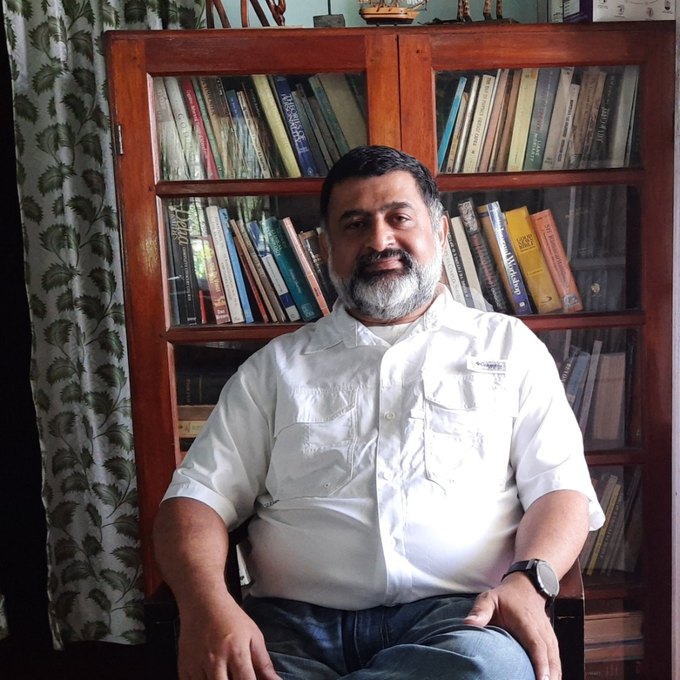
Dr. Mathai B. Fenn seated in front of his library

Dr. Mathai B. Fenn

Dr. Mathai B. Fenn (PhD, Department of Humanities and Social Sciences, IIT Bombay) is a psychologist, educator, management consultant, and founder of The Talk Shop. Over three decades in academia and consulting, he has served as Associate Professor and Chairperson of the Organizational Behaviour Area at XLRI Jamshedpur, Dean at New Shores International College, Bangalore, Visiting Faculty and Academic Coordinator at the National Rail and Transportation Institute (NRTI), Vadodara, and visiting faculty at IIM Kozhikode, IIT Gandhinagar, Tata Institute of Social Sciences (TISS), Mumbai, XIMB, MICA, and the American University of Armenia (AUA). His corporate consulting and executive education work spans India and the Middle East, focusing on decision-making under ambiguity, organisational design, human-centred leadership, and cognitive adaptation in the age of AI.

Contact & Enquiries

Dr. Mathai B. Fenn | The Talk Shop

Fenn Hall, Collectorate PO, Kottayam 686002, Kerala, India

Phone / WhatsApp / Telegram: +91 9980051414
Email: mathai@thetalkshop.in

START A CONVERSATION