THE TALK SHOP · THOUGHTS AND PERSPECTIVES
The Roots of Understanding
A journey into the enduring ideas and insights on how we understand the mind and human experience.
What if one day you woke up and realised that the everyday world you knew—coherent and familiar as it was—was only part of a much larger reality? Nothing about the practical business of living changes: you still go to work, meet people, and make choices. What shifts is your relationship to it—what you notice, what you take for granted, and how you make meaning.
The Talk Shop grows out of this inquiry into what it means to be human. Bringing together psychology, Gestalt thinking, philosophy, and attention to lived experience, it invites you to step back from familiar habits of seeing and explore a simple, practical question: how can we learn to see ourselves, others, and our situations afresh?
What Makes Us Human?
Not long ago, I spoke with a man who had retired after years of working abroad, returned to India, and opened a small shop in his hometown. When I asked him about it, he told me he had opened the shop mainly to reconnect with his community and meet the people of his locality. To me, it was a quiet reminder: economics is not the only reason or even the main reason why people do work or conduct business.
For much of the twentieth century, Psychology sought to understand people by observing, measuring, and explaining behaviour through general laws. Those methods have taught us much—yet they rarely capture the simple human reasons behind why we do what we do.
From Explaining to Understanding
There are many ways I can study a book. I can measure its weight, its volume, the printing ink, or the fonts used. Yet the only way to understand what the book says is by reading it. Perhaps reading a human being is not very different.
Before Psychology became an experimental science, the German philosopher Wilhelm Dilthey made this exact distinction: between Erklären—explaining behaviour from the outside through observation and general laws—and Verstehen—understanding human experience from within. Human beings do not merely behave; we remember, interpret, create meaning, and act with intention. To understand someone, we have to read what the world means to them.
Seeing the Whole
Around the beginning of the twentieth century, Max Wertheimer, Wolfgang Köhler, and Kurt Koffka challenged the reductionist tendency to understand a whole by breaking it into smaller parts. Their work became known as Gestalt Psychology.
Over a century ago, the psychologist Wolfgang Köhler paused while writing and described the world exactly as he found it: a blue lake framed by dark forests, a cool grey stone serving as his chair, the faint wind in the trees, the smell of fishing boats—and, unbidden, a memory of another lake in Illinois alongside a sudden, dark pressure inside him about a looming manuscript deadline.
For Köhler, this immediate, unedited tapestry of sensation, memory, and feeling is the only true starting point for understanding human beings. Long before we measure, categorise, or explain, we live inside a whole, coherent experience. Gestalt Psychology began with that simple insistence: the way we organise this lived whole shapes everything we notice, feel, and do. Germans had a word for it: Erlebnis. (Read Köhler's account here.)
Most education treats learning as steady accumulation—gathering facts and techniques piece by piece. That incremental path builds useful competence, yet it leaves our underlying way of seeing untouched.
Transformative learning works differently. Rather than adding more information, it reorganises the whole pattern of how we make sense of things—bringing that sudden Aha! moment when familiar pieces click into a new whole. In a well-known experiment, a chimpanzee tries to reach bananas just out of reach. He cannot reach them even with the longest stick.
He stares at the sticks for some time, and the whole situation suddenly rearranges itself: he joins the three sticks together and reaches the bananas with ease. Nothing new was added to the room, yet the whole situation rearranges itself in a sudden flash. You cannot force that shift by pushing harder; it emerges when we pause, look closely at our own lens, and allow a new understanding to take shape.
Questions Worth Keeping Open
In modern textbooks, Gestalt Psychology is relegated to a few examples of visual organisation and a short note in the learning section. What if we used this way of thinking not only to study perception, but to examine how we experience the world, form relationships, learn, and make decisions? What assumptions quietly shape what we notice—and what becomes invisible when we look at people only as objects to be measured, managed, or changed?
These questions sit at the heart of The Talk Shop. They invite us to look again at what we take for granted, notice the limits of familiar explanations, and make room for deeper understanding.
How I Got Here
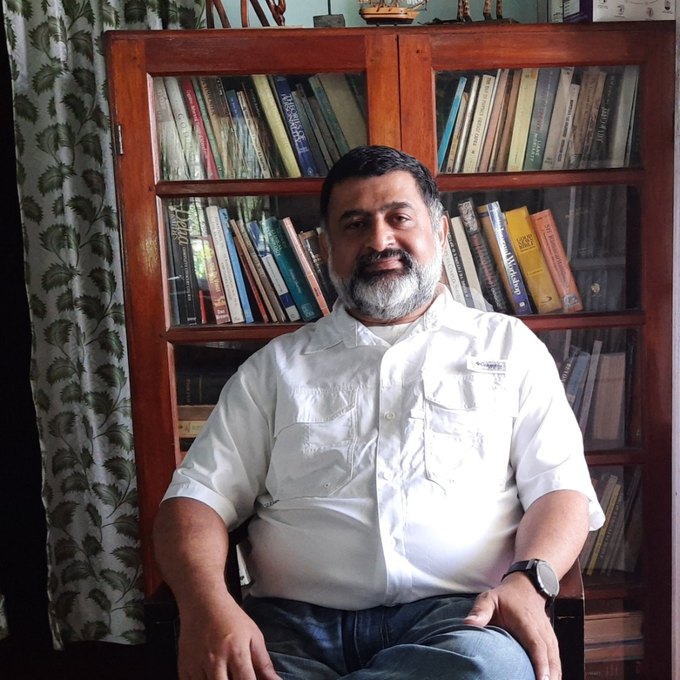
Full biography & credentials →
I grew up as the son of a psychiatrist. Conversations at our dinner table often turned to human nature and how we understand one another—yet even then, I sensed something was missing from accounts of people built solely on what could be observed and measured.
That curiosity led me to Psychology, and on to IIT Bombay, where I studied not only what Psychology tells us, but the assumptions behind its ways of knowing. Everything I did after my PhD was to apply what I had learnt to different contexts of human activity—both in classrooms at places like XLRI Jamshedpur, IIT Gandhinagar, and the American University of Armenia, and by designing and delivering training programmes for a number of organisations facing real questions of people, work, and change.
Over time, my focus narrowed to a single thread: the human side of human behaviour. How do we create meaning? And how is human intelligence distinct from artificial intelligence and the intelligence of other animals?
The Talk Shop grew out of that continuing inquiry—bringing Psychology, Gestalt thinking, and lived experience together to look again at what we take for granted.
These are not just abstract philosophical questions. They influence how we understand ourselves, relate to others, learn, work, and live. The Talk Shop's educational and developmental programmes have grown out of this continuing exploration. They bring together Psychology, Gestalt thinking, and attention to lived human experience. Each takes up a different aspect of being human, while sharing a common purpose: to question familiar assumptions, see situations afresh, and discover new possibilities for understanding and growth.
Closing thought: The invitation is simple: stay curious, look again, and begin your own exploration.
The Questions That Continue
All these raise several questions that need answers. Some can be answered in words, while others can only be answered experientially:
- What is the purpose of life? How does it affect how we live and work?
- What if the person others know me as is just one part of me, a mask I wear? Can I take off my mask and see myself as I truly am... or even when I look in the mirror, do I see a masked person?
- How do I see another human being—as a person who deserves to be heard, who deserves respect and dignity... or as an object, an instrument that helps us achieve something else?
- Do I see the world really as it is? Or do I introduce my bias? How much of what I see and how I behave is controlled by habits and Gestalts? How do I know? How can I change?
- Why do we identify ourselves with our intellect and intellectual understanding of the world? What is the difference between AI and HI? What is the role of humans in a world with increasing AI? What is AGI, or ASI (Artificial Superintelligence—hypothetical AI that surpasses human cognitive capability across every domain)? Will AI wake up and declare war on humans? What does WAKE UP mean?
- What limits me from learning and growing? What am I afraid of?
What Guides My Work
Some conversations begin with a clear personal question, while others start with a complex problem—a difficult choice, a strained dynamic, or a shifting reality—yet the focus always returns to the human being at the centre of it. Rather than starting with formulas or sorting people into neat labels, I begin with how a person actually experiences what is happening, using dialogue to bring hidden patterns and inherited habits into view so new possibilities can open up. At the heart of this work is meeting another person as a whole human being. They are not just a role, a function, or a means to an end. It also means treating ethics as something everyday—knowing what is right and actually doing it, even when money or convenience pulls the other way, or when the outcome is uncertain. And as new tools and technologies—including artificial intelligence—reshape how we work, they should stay in service of human judgment and care, never replacing the living human presence that gives our work meaning.
A few quiet commitments guide how I work, whether I am sitting in a one-on-one conversation, a leadership retreat, or an open workshop:
- Listening fully: A person's own account of their experience is valuable, and my first responsibility is to listen to it completely rather than rushing to interpret or label it.
- Holding alternative explanations: Rather than searching for a single "correct" truth, we explore alternative ways of reading the same events so the person can choose the perspective that genuinely helps them move forward.
- Making room for transformational learning: Most of our lives are occupied with incremental learning—adding skills and facts piece by piece. My work focuses on transformational learning, where a person comes to see the whole situation in a different light altogether.
- Remembering a deeper reality: Beyond our day-to-day experience lies a larger, deeper reality. Keeping that in view loosens our fixation on our own ego and identity, opening space for humility and clarity.